
What is Ancestral Healing?
An introduction to the ancestor work you can expect to find here at Ancestral Medicine, and direction for where to begin.
Welcome
The ancestors are our roots and mycelia. To relate with them is to deconstruct the isolation of an individualistic understanding of self and find ourselves in an expanded web of interconnection. Our approach to ancestral healing is nourished by established traditions of ritual arts, animist and Earth-honoring values, psychology and healing arts, and a deep commitment to positive cultural change.

Work with a practitioner
All practitioners have completed an intensive nine-month training, maintain certification through Ancestral Medicine, and commit to maintain a code of ethics. Sessions are available in 20+ languages and nations, and those in the Network have widely varied skills, identities, and interests. This option is the most personal and many practitioners offer sliding scale rates.
Take the course
The course offers 12 live teaching calls and 12 accompanying pre-recorded lessons, plus an additional 12 live calls to practice your ritual skills. You’ll have unlimited access to the recordings and a deep archive of resources. You’ll also be added to our connection space where you can connect with others in the course. Live lessons are taught by Daniel Foor and others in the network (teachers rotate seasonally). Thousands of people have taken the course, and hundreds have taken it more than once.
Attend a retreat
Each year, we gather in global cities for three to five days of intensive Ancestral Healing. Some events are all-inclusive and others non-residential to offer flexibility for different budgets. The work includes rituals, trance work, drumming, singing, sharing and learning in large and small groups. Live whisper translation is often available for accessibility in the local language.
Read the book
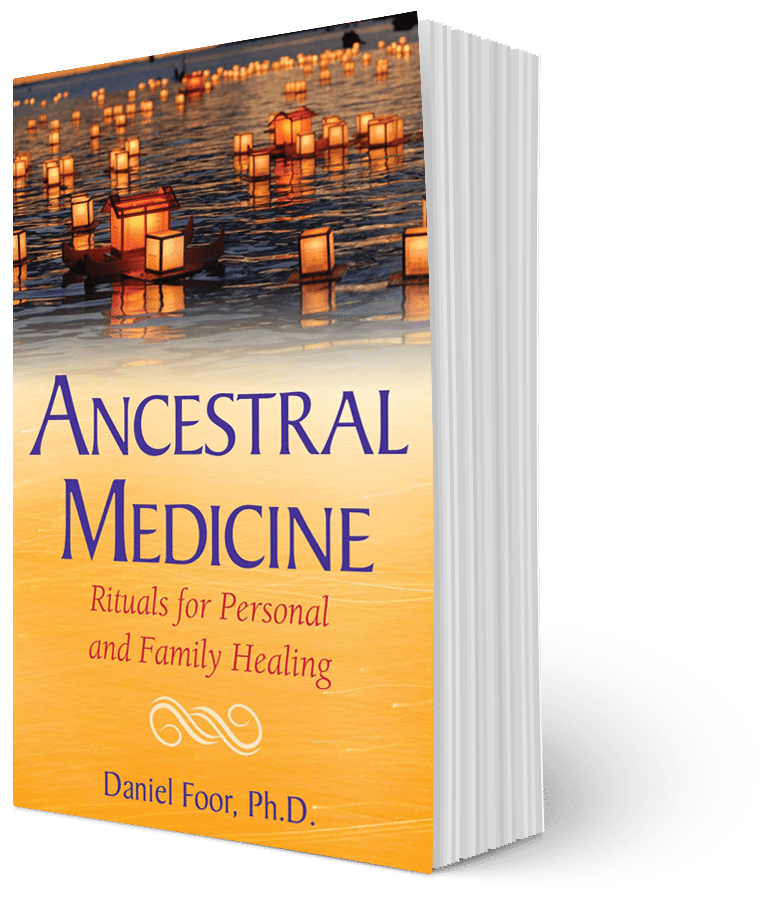
Whether you’re a self-starter or like to prepare in advance, our book offers an affordable way to begin. Read it first, or dive deeper later with our courses.
Listen to a free introductory talk
Watch in
or in one of 20+ other languages
Daniel speaks for 90 minutes on the basics of Ancestral Lineage Healing, the method of ancestral healing he created. This talk is intended to serve as an intro to the work, and it’s been lovingly translated into more than 20 languges by our diverse polyglottal network. See also this blog post on language inclusivity at Ancestral Medicine.
- find your language
- العربية (Arabic)
- বাংলা (Bengali)
- Bosanski (Bosnian)
- Bahasa Indonesia (Indonesian)
- Български (Bulgarian)
- Català (Catalan)
- Čeština (Czech)
- Deutsch (German) – Coming Soon
- Ελληνικά (Greek)
- English
- Español (Spanish)
- فارسی (Farsi)
- Français (French)
- हिंदी (Hindi)
- עִברִית (Hebrew)
- Italiano (Italian)
- ქართული (Georgian)
- Magyar (Hungarian)
- Polski (Polish)
- Português (Portuguese)
- Română (Romanian)
- Русский (Russian)
- Suomi (Finnish)
- Türkçe (Turkish)
- اردو (Urdu)
- 中文 (Chinese)
Attend Ancestral Healing for Beginners
We recognize this work can sometimes feel overwhelming to newcomers, especially for seekers with a healthy dose of skepticism. To help you wade in, we offer this beginner-level two-part series. It’s only $45, and this fee can go toward your entry into the twelve-week course if you decide you’d like to continue.
How can ancestor work help me?
Engaging in ancestral healing can free us from painful legacies and transform intergenerational burdens into ancestral blessings. Many who undergo this process experience a renewed sense of peace, deep rootedness, and healing in personal relationships and cultural identities.
The work, while personal, is also cultural. By helping to ancestralize the unwell dead, we contribute to healing our culture. Many of the social toxins troubling today’s world— sexism, racism, rigid dogmatism, supremacies of all kinds to name a few—can be attributed to reflections of unmetabolized ancestral troubles.
This work encourages peacemaking with living family members and can positively impact relatives affected by ancestral burdens, even if they aren’t directly involved in the process.
Tending the health of our ancestral lines also helps clear the way for our eventual transition to the next reality.
How does healing the wounds of my ancestors help me?
Ancestral healing, when done safely and effectively, disrupts harmful patterns and supports mental, emotional, and physical health. By resolving generational pain, we can more fully embody our personal destiny. In relationship with our well ancestors, we access deeper rootedness and power, including in our work to transform oppressive systems. Healing ancestral wounds also clears the way for our eventual transition to the next reality.
What if I don’t know who my ancestors are?
Many people across the planet don’t know where they came from beyond a certain point. Even people who can trace their ancestry fifteen or more generations back still come from hundreds of generations beyond what’s knowable. Sometimes the not-knowing actually makes the work easier, because you don’t have pre-determined stories. We know this is sensitive for many people in diaspora and for adoptees. Everyone is warmly welcome, and this work accommodates those vulnerable realities with a keen eye toward cultural awareness and safety.
I’m drawn to this but I don’t know if I believe it’s real.
That’s okay. We’re very non-dogmatic. Meaning we don’t require any particular set of beliefs. Explore our website FAQ for more on this. If you’re drawn to the work, and you think we might be your people for this, perhaps roll the dice and listen to that. If it turns out not to be your thing, so be it.
Who are “the ancestors”?
Our approach to ancestral connection for healing is rooted in global traditions of ritual arts and is deeply symbiotic with approaches like psychotherapy, family constellations, and parts work.
Unlike some methods, participants in Ancestral Lineage Healing are never asked to embody or relate directly with the troubled dead or other unsafe forces.
There’s no need for prior experience with the ancestors, and the practices are safe, accessible, and inclusive of different cultural backgrounds.